
Orthopedics · Shoulder
Dislocated and unstable shoulder
Has your shoulder come out of its socket and you have not trusted it since, or does it keep dislocating? Surgery can tighten the ligaments and the rim of the socket and, where needed, replace missing bone. A freshly dislocated shoulder, however, belongs first in an emergency trauma department.
- No referral from a general practitioner needed
- Operated on by Prof. MUDr. Radek Hart
Under general or regional anesthesia
- fresh dislocation
- urgentgo to an emergency trauma department or urgent care, not to a clinic office
- anesthesia
- generalor regional, often a combination of both
- after bone reconstruction
- 4–6 monthsthe whole rehabilitation usually takes
- until the procedure
- 1 weekfrom the consultation, if everything is in order
01When a procedure is considered
A shoulder that keeps dislocating
The head of the upper arm bone sits in the shallow socket of the shoulder blade. It is held in place by the joint capsule with its ligaments, by the cartilage rim around the edge of the socket (the labrum), which acts as a bumper, and by the muscles of the rotator cuff.
-
After the first dislocation
Most often the head slips forward, typically in a fall or injury with the arm raised away from the body. The capsule, ligaments and rim of the socket often tear in the process. After a first dislocation the risk of another is higher; it depends mainly on age and on how the shoulder heals.
-
Repeated dislocation
The shoulder comes out again, sometimes even without an injury, or it only “slips partway” and returns by itself. The feeling remains that it is loose. With repeated dislocations, bone at the edge of the socket or on the head of the upper arm bone may wear away.
-
Loose ligaments
Some people have naturally looser ligaments, and in others repeated overhead movement stretches them, for example swimming, tennis, volleyball or work with the arms above the head. The shoulder can then be painful and unstable even without a dislocation.
-
When to come for an examination
When the shoulder repeatedly dislocates, slips partway, or you feel it is slipping out. A freshly dislocated shoulder belongs first in an emergency trauma department or urgent care; do not try to put it back yourself. The clinic's office is not an emergency service; come for examination and further treatment afterward.
- cartilage rim of the socket
- joint capsule and ligaments
- shoulder bones
- original position of the head
02When to operate
When surgery makes sense
A stabilizing operation is considered when the shoulder dislocates repeatedly, the feeling of instability remains, or the bones or muscles of the shoulder are damaged. Whether and when to operate is decided by the doctor at the consultation.
Symptoms
The shoulder keeps coming out
Sometimes even without an injury.
- Repeated dislocations or slipping partway
- A feeling that the shoulder is loose and slips out of the joint
Findings
Damaged bone or muscles
The images show it.
- Bone loss at the edge of the socket or on the head of the upper arm bone
- Damaged shoulder muscles
Risk
Young athletes
Sometimes already after the first dislocation.
- In young athletes, surgery is sometimes considered already after the first dislocation
- We will discuss the risk of another dislocation with you based on age, activities and findings
Not sure whether surgery is right for you? The examination will decide. Book a consultation
03How the procedure goes
From booking to going home
The aim of the operation is to give the head firm support in the socket again. Depending on the findings, torn ligaments and the rim of the socket are tightened or sutured, and where bone is missing it is added or reconstructed. Some procedures are done arthroscopically, with a camera through small openings, others openly through an incision over the shoulder. What is suitable for your shoulder is discussed with you by Prof. Hart after the examination and images.
-
Booking
Online or by phone. A referral from a general practitioner is not required.
online or phone -
Consultation and examination
Prof. Hart examines the stability, mobility and strength of the shoulder. The bone is shown by X-ray or CT, the ligaments and rim of the socket by MRI.
diagnosis and treatment plan -
Procedure
Under general or regional anesthesia, often a combination of both, as agreed with the anesthesiologist.
as soon as within a week of the consultation -
Home
After the procedure you stay for observation and go home with your arm in a sling as soon as everything is in order. Do not drive after anesthesia; an escort must take you home.
check-up and physiotherapy
04Recovery and physiotherapy
Stability is completed by exercise
Healing of ligaments and bone is a slower process. For returning to all activities, thorough rehabilitation matters most. We set the plan according to the procedure, and we can follow up with physiotherapy directly at the clinic.
-
Sling
After surgery, a sling protects the shoulder for a while. How long is determined by the doctor according to what was done in the joint.
-
Exercise for movement, then for strength
Once the sling comes off, exercises for range of motion begin so that the ligaments heal without unnecessary scarring. The physiotherapist then gradually extends the plan with strengthening.
-
Stiffness after surgery
The shoulder may be stiff for a while after surgery. That is exactly why physiotherapy after the procedure is so important.
-
Return to work and sport
When you may return to driving, work and sport is decided by the doctor or physiotherapist. After a bone reconstruction, the whole rehabilitation usually takes 4 to 6 months.
05Who operates
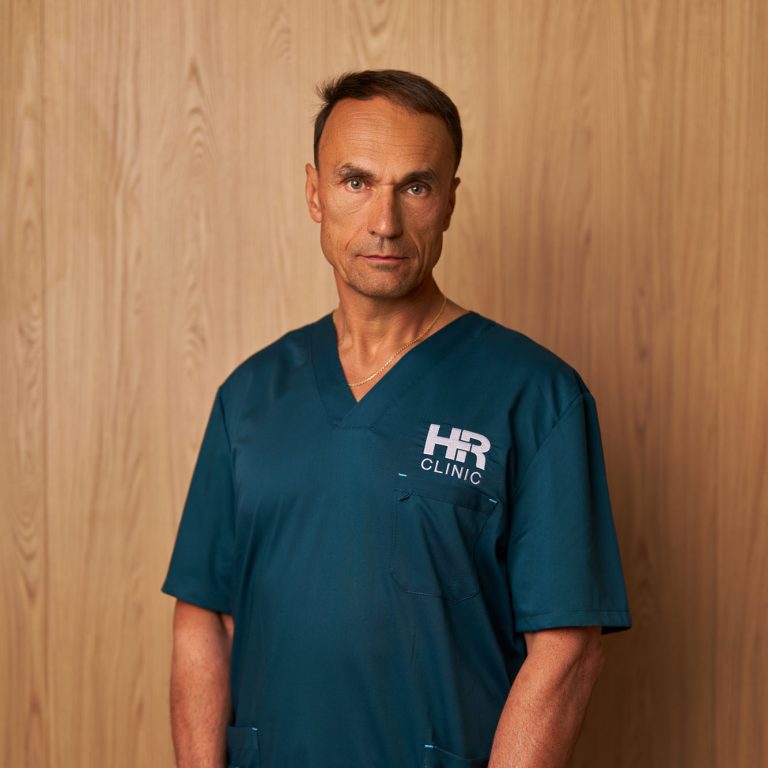
Prof. MUDr. Radek Hart, Ph.D., FRCS, MHA
Orthopedic surgeon and trauma specialist of the musculoskeletal system, head physician of HR Clinic. He sees patients in Znojmo and in Vienna; after a consultation in Vienna, the procedure can be performed in Znojmo. Surgery takes place in operating theaters with laminar airflow; for arthroscopy the clinic has optics for 4K arthroscopy.
More about Prof. Hart Professional site ortho-hart.at
Price We will tell you the price of the procedure at the consultation, depending on the findings and the extent of the surgery.
06Frequently asked questions
What patients ask most often
Related pages and articles
Shoulder arthroscopy Swimming and shoulder pain: what “swimmer's shoulder” is How it works at HR ClinicMy shoulder has just come out. Should I come to the clinic?
No, a fresh dislocation is an urgent injury. Have yourself taken to an emergency trauma department or urgent care, do not drive yourself and do not try to put the shoulder back. Until then, support the arm with a sling or towel and apply a cold pack wrapped in cloth. After treatment you can book with us for a follow-up, further treatment or a second opinion.
What is done in shoulder surgery?
The aim is to give the head firm support in the socket again. Depending on the findings, torn ligaments and the rim of the socket are tightened or sutured, and where bone is missing it is added or reconstructed. Some procedures are done arthroscopically, with a camera through small openings, others openly.
How do I know the shoulder is unstable?
The shoulder repeatedly dislocates or slips partway, you feel it is loose and slipping out of the joint, and it hurts. Sometimes the head slips out only partly and returns by itself. Such a partial dislocation is harder to recognize but can recur.
Will I be awake during the procedure?
Shoulder stabilization is done under general anesthesia, under regional anesthesia in which the shoulder and the whole arm are numbed, or under a combination of both.
What are the risks?
As with any operation, infection, bleeding, a blood clot or damage to a blood vessel or nerve can occur. The shoulder may be stiff for a while after surgery, which is why physiotherapy is important. The doctor will discuss the risks with you before the procedure.
Do I need a referral from a general practitioner?
No. You just book online or by phone.
How soon can I have the procedure?
If everything is in order, the procedure can take place as soon as within a week of the consultation. We set the date according to the result of the examination.
07Booking
Book an orthopedic consultation
Online or by phone, at the clinic in Znojmo. A referral from a general practitioner is not required.
- +420 515 225 520
- info@webdemo.dam-medizin.com
- Kotkova 3974/9c, 669 02 ZnojmoMon: 8:30–15:00 · Tue–Fri: by appointment